
What Is The Blumlein Pair Technique?

Over the past few decades, there has been a great evolution in different types of recording methods. Although some might not realize it, good microphone placement and techniques are crucial for high-quality audio recordings and have significantly altered how music is listened to. It’s vital to be aware of various miking procedures that can elevate your work regardless of the kind of recording you’re performing, such as audio for a movie or music.
This article takes a closer look at the Blumlein pair microphone technique, one of the finest stereo recording methods that engineers still use today. The Blumlein technique is especially valued for its realistic stereo imaging and natural sense of space.
Origin of the Blumlein Technique
The Blumlein pair technique originates in Alan Blumlein’s initial stereo recording attempt. In 1931, Blumlein was an engineer for EMI and created a sonic reproduction of an abbey road soundstage. The stereo recording became a reality at this point. Blumlein called his initial attempts a “binaural” sound. He used omnidirectional microphones to capture the stereo effect because “figure 8” configuration microphones were unavailable. However, he presented a theoretical and crude use of the Blumlein pair employing directional microphones in his 1931 patent application filed in the UK. As a result, Blumlein also created the mid-side recording method, another stereo recording method that studio pros frequently employ.
Types of Microphones for the Blumlein Pair Technique
Stereo ribbon microphones have been produced by many companies, especially for Blumlein pair applications. These include AES, Royer, and B&O. That being said, you may use almost any high-end ribbon or condenser microphone for this application.
When selecting microphones for a Blumlein pair mic setup, engineers typically look for:
True figure-8 polar patterns (non-negotiable for the Blumlein technique)
Matched or closely matched microphones for consistent stereo imaging
Ribbon microphones for a smooth, natural room response
Condenser microphones with switchable polar patterns for added flexibility
Manufacturers have advised using Blumlein array configurations of stereo condenser microphones, including AKG and Neumann. Additionally, you may employ microphones with adjustable pattern settings, as long as both microphones are set to a true figure-8 polar pattern, which is essential for achieving an accurate and balanced Blumlein pair microphone technique.
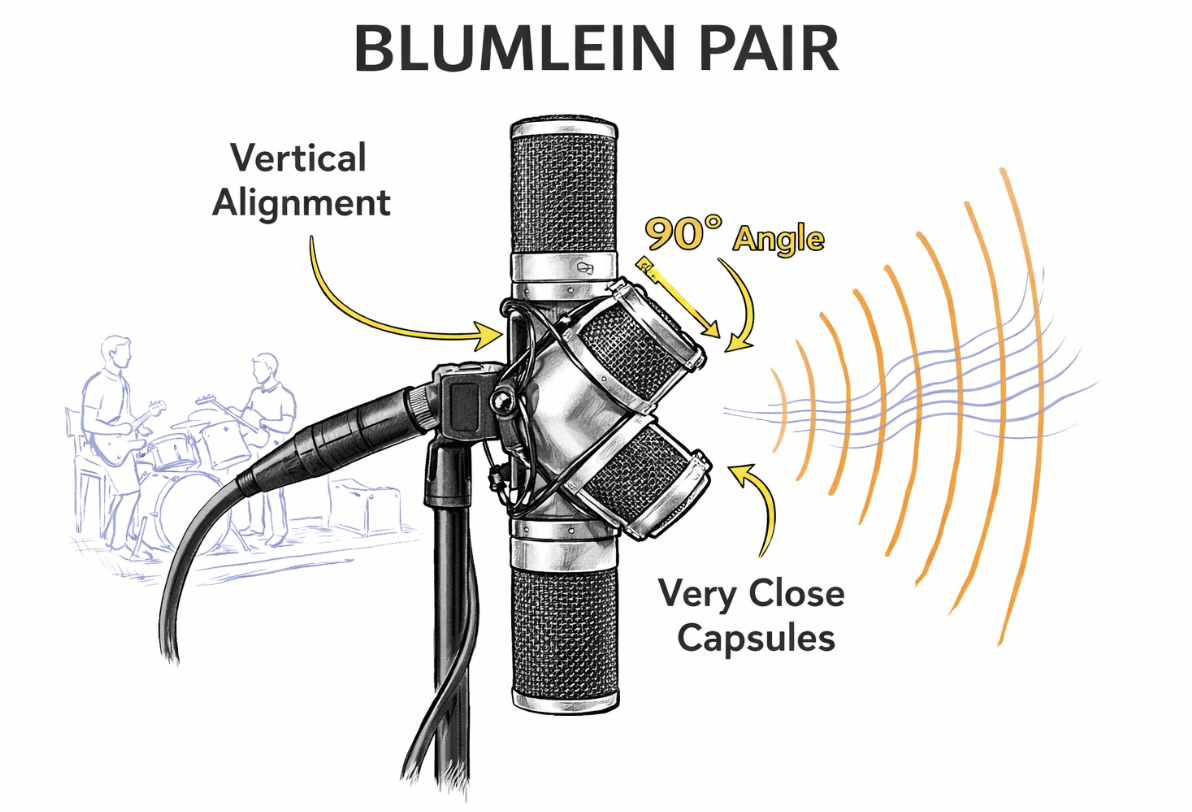
How Is the Blumlein Pair Created?
Most diagrams do not show that the Blumlein pair is oriented perpendicularly to the sound source on a vertical axis. If you were using this method to record a band performing, the mics would be arranged one on top of the other. Additionally, the front ends of both microphones must be positioned to form a 90-degree angle and as close to one another as possible.
When this is accomplished, the intersection of these two lines should be in the direction of your sound source. Similar to the human ear, this method produces a wide feeling of space and a direct center image. Your audience will genuinely experience the performance as though they were present in the same room as you.
Tips for Searching for a Blumlein Mic Setup
For engineers searching specifically for a Blumlein mic setup, the process can be simplified into a few clear steps:
Use two matched figure-8 microphones (ribbon or condenser)
Mount the microphones so their capsules occupy the same point in space
Angle the microphones at 90 degrees to each other
Align the center of the crossed pattern directly toward the sound source
Start with the pair positioned 3–6 feet from the source and adjust based on room size and desired ambience
Small positional changes can dramatically affect the stereo image, so careful placement is key when using the Blumlein pair technique.
When Should You Use the Blumlein Pair Technique?
The Blumlein pair microphone technique excels when recording sources where room acoustics are an intentional part of the sound. Common use cases include:
Small ensembles or acoustic groups
Piano, string quartets, or jazz recordings
Choirs or vocal groups in well-treated rooms
Ambient room capture for orchestral or cinematic music
Because the technique captures sound equally from the front and rear of the microphones, it performs best in spaces with balanced, controlled reflections.
Are There Any Disadvantages to This Technique?
The Blumlein pair will not work well for any purpose other than as a “room microphone.” Too much ambient noise and a loss of low-frequency tones might also arise from placing your pair too far away from your music source, giving you subpar sound quality. Finding the ideal location or spot for the Blumlein pair is the most challenging aspect of the setup; try different positions and heights until you discover it. In untreated or acoustically poor rooms, the technique may exaggerate unwanted reflections rather than enhance realism.
Blumlein Pair vs Other Stereo Mic Techniques
Understanding how the Blumlein pair compares to other stereo recording techniques helps engineers choose the right tool for the job:
Blumlein Pair vs XY:
XY uses cardioid microphones and produces a narrower stereo image with less room ambience, while Blumlein delivers greater depth and spatial realism.Blumlein Pair vs ORTF:
ORTF introduces time-based stereo separation and works well in less-than-ideal rooms, whereas Blumlein relies more heavily on room acoustics.
Blumlein Pair vs Mid-Side:
Mid-side offers post-recording flexibility in stereo width, while Blumlein captures a fixed, highly realistic stereo field at the source.
Improve Your Sound: Record at One of Our Santa Monica Recording Studios
At lmnl studios, we have the ideal recording studios accessible 24/7, whether your goal is to further your hobby or provide a new base of operations for your clientele. Our studios are open around the clock and fitted with top-tier equipment to ensure you receive the optimal sound possible.
Professionally designed rooms make advanced techniques like the Blumlein pair microphone technique shine, allowing engineers to capture depth, clarity, and realism without compromise. Book a studio today!
